Systematic Withdrawal Plan (SWP)

What is Systematic Withdrawal Plan (SWP)?​
Systematic Withdrawal Plan (SWP) is the facility by which an investor can withdraw a pre-determined amount from his existing investments in mutual funds at a pre-decided interval (weekly, monthly, quarterly, semi-annually or annually). Functionally, Systematic Withdrawal Plan (SWP) is similar to Systematic Investment Plan (SIP) but it gives an option to withdraw systematically. This helps in generating a regular cash flow for the investors. SWP in mutual fund is one of the most effective and tax efficient way to earn potential returns.​
Key benefits of ​SWP
  • Tax advantage- In case of investments in equity mutual funds for a period of more than a year, the long term capital gain is exempted. Only short term capital gains are taxable at the rate of 15% (if the total income does not exceed INR 1 Crore) on withdrawals from equity mutual funds investment within 1 year. Whereas in case of investments in debt schemes, the short term capital gain (invested period is less than 3 years) is added to the investors’ income and taxed as per their tax slab. Long term capital gains in debt schemes are taxed at the rate of 20% with indexation. In Systematic Withdrawal Plan (SWP), the tax is paid only on the gains made due to the NAV movement and not on the principal part in the withdrawals making the overall tax incidence lesser. Unlike SWP, in traditional investment options the entire gain is taxed according to the investors’ tax bracket (the highest currently being 30 %) considering if the investor falls under the highest tax bracket.​
  • Regular supplemental income- The option of SWP in mutual fund can help you by providing a steady source of income from your investments. This is especially useful for those who need money when their cash flow comes to a halt like retirement, or at a time when supplemental income becomes a necessity due to the altered circumstances in life.
  • Meet financial goals- If planned well ahead of time, SWPs can provide a steady flow of money when most needed. They can therefore be linked to long term financial goals, such as providing a steady income in one’s retirement years or managing your child’s educational expenses.

Who can use SWP?
Systematic Withdrawal Plan (SWP) can be utilized by those who are planning for their retirement in the coming years. Usually the large amount of money that one receives at the time of retirement is invested in traditional savings instruments which attract income tax at the normal rates. Instead, they can make a lump sum investment in mutual funds with SWP facility. In this case, along with earning capital appreciation on the invested amount, he/she can receive a fixed amount monthly. It will help you in getting a regular income like salary even after retirement.​​
However, the use of SWPs may not be restricted to retirees alone. It is also useful for middle-aged professionals who have the responsibility of their family. They can use SWP option to get a constant source of fund for their dependents. They can plan it for their child’s educational expenses. They can even plan for a constant source of money for their retired parents.​​

SWP calculators are also available. One can easily make all the necessary calculations before investing. The SWP calculator helps in determining the amount to be invested, withdrawal amount and the tenure. It also helps in understanding SWP meaning in mutual fund in a better way.​​
A m​​utual fund SWP is designed keeping in mind the needs, interests and financial goa​​ls of the investors. By judiciously using tools like Systematic Investment Plan (SIP) and Systematic Withdrawal Plan (SWP), you can meet your financial goals without having to go through the hassle of timing the markets and making wrong financial decisions that may cost you dearly and throw you off track. ​​​
​ 
Tax efficiency through SWP​​


WITHDRAW HAPPINESS THAT’S TAX EFFICIENT

Amount Investment


Click on Image to see Large picture


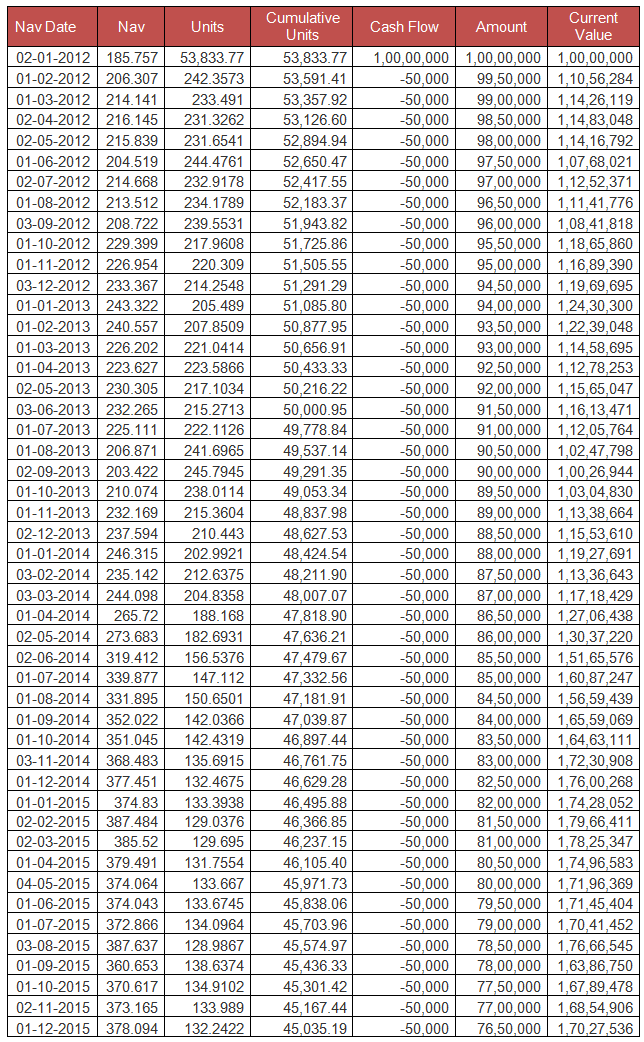
Mutual Funds - The cash flows and investment value

Above is the tabular Presentation of HDFC Prudence fund with Initial investment of 1Cr.. and monthly withdrawal of 50000, means you are withdrawing 6% PM and still having left with huge corpus after 3 years


As you can see, withdrawals through SWP are tax-efficient as you only pay 3,233 as tax on your gains, i.e. 0.90% on withdrawals of 3.6 lakhs, as compared to a traditional savings instrument where you pay 1,11,240 on your gains.

Now, there is a further twist in this.. In case you decide to start withdrawing funds after 1 year..
then you need not to pay any tax as all EQUITY LONG term gains are tax free...

Happy Investing..
Sunrise financial services
Disclaimer:- This is a representation of facts, actual returns may vary according to market conditions.

Sources: SBI Mutual Fund Knowledge center

Money vs Capital Market

Quote ARN -99994 for all Equity/Debt and ELLS mutual funds
EUIN - E120123
Money Market vs Stock Market


An investor has always confusion regarding where to  investment in Stock market or Money market
There are two types of financial markets viz. the money market and the capital market. The money market in that part of a financial market which deals in the borrowing and lending of short term loans generally for a period of less than or equal to 365 days. It is a mechanism to clear short term monetary transactions in an economy. 
.
what is stock market…?
Most of the reader or investor must me very well known with the term “stock market” and so we not discussing much of it and so just sharing a small introduction. 
The market in which shares are issued and traded either through exchanges or over-the-counter markets. Also known as the equity market, it is one of the most vital areas of a market economy as it provides companies with access to capital and investors with a slice of ownership in the company and the potential of gains based on the company’s future performance. 
;
  

What is money market?
The most of the investor is not aware of this market and fact regarding the same. you as a investor think are you aware of what is money market it advantage or more basic thing which instruments can be included  in this category today in this article i am going to share very basic thing of money market even we will compare the both financial market.
A segment of the financial market in which financial instruments with high liquidity and very short maturities are traded. The money market is used by participants as a means for borrowing and lending in the short term, from several days to just under a year. It is part of debt market.

Money market instruments

.
Short lsit of important money market instruments to make you aware
§ Money Market Instruments
§ Treasury Bills (T-Bills)
§ Commercial Papers (CPs)
§ Repurchase Agreements (Repo)
§ Banker’s Acceptance
.
Advantages of money market instrument

Asset Preservation
In spite of the relatively low returns, the money market can be a great way for investors to preserve, and even make, a little bit of money.
.Liquidity
The biggest advantage and the most attractive feature of the money market is liquidity.
.Risks
There are risks in every investment, but the money market is probably one of the safest places for your capital. After all, the funds are invested in relatively secure government or other short-term, high-quality debt.
.
 Yield
 Money market funds pay a yield based on the holdings of the underlying fund. The yield is generally automatically reinvested into the fund via purchase of additional shares in the fund. This yield makes money market funds an attractive alternative to the mattress.
.
Comparison of money market and stock market
.Capital markets are perhaps the most widely followed markets. Both the stock and bond markets are closely followed and their daily movements are analyzed as proxies for the general economic condition of the world markets. As a result,
the institutions operating in capital markets – stock exchanges, commercial banks and all types of corporations, including nonbank institutions such as insurance companies and mortgage banks – are carefully scrutinized.


1. Maturity Period:
The money market deals in the lending and borrowing of short-term finance (i.e., for one year or less), while the capital market deals in the lending and borrowing of long-term finance (i.e., for more than one year).
.
2. Credit Instruments:
.The main credit instruments of the money market are call money, collateral loans, acceptances, bills of exchange. On the other hand, the main instruments used in the capital market are stocks, shares, debentures, bonds, securities of the government.
.
3. Nature of Credit Instruments:
.The credit instruments dealt with in the capital market are more heterogeneous than those in money market. Some homogeneity of credit instruments is needed for the operation of financial markets. Too much diversity creates problems for the investors.
.
4. Institutions:
.Important institutions operating in the’ money market are central banks, commercial banks, acceptance houses, nonbank financial institutions, bill brokers, etc. Important institutions of the capital market are stock exchanges, commercial banks and nonbank institutions, such as insurance companies, mortgage banks, building societies, etc.
.
5. Purpose of Loan:
.The money market meets the short-term credit needs of business; it provides working capital to the industrialists. The capital market, on the other hand, caters the long-term credit needs of the industrialists and provides fixed capital to buy land, machinery, etc.
.
6. Risk:
.The degree of risk is small in the money market. The risk is much greater in capital market. The maturity of one year or less gives little time for a default to occur, so the risk is minimised. Risk varies both in degree and nature throughout the capital market.
.
7. Basic Role:
.The basic role of money market is that of liquidity adjustment. The basic role of capital market is that of putting capital to work, preferably to long-term, secure and productive employment.
.
8. Relation with Central Bank:
.The money market is closely and directly linked with central bank of the country. The capital market feels central bank’s influence, but mainly indirectly and through the money market. Capital markets shows lot of volatility moves with Central Bank ‘s(RBI ) Monetary and credit policy related to liquidity.

Please refer to my post "Investment Planning Part -1" for more understanding of capital and money market funds.

http://feeds.feedburner.com/~r/Moneymunch/~4/8pKnv_2lr8c?utm_source=feedburner&utm_medium=email

Hits